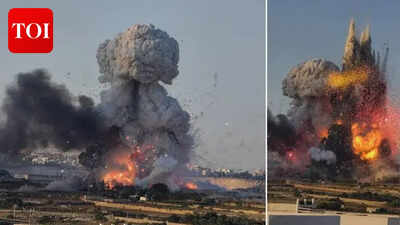
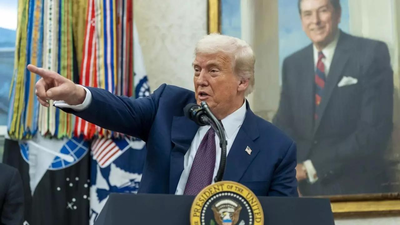
TOI correspondent from Washington: Just hours after US President Donald Trump assured Americans that Iran “really wants to make a deal” and urged “negatively chirping” critics to “sit back and relax (because) it will all work out well in the end,” the Middle East moved in the opposite direction.The three-month-old conflict lurched back toward open warfare on Monday as both sides reported fresh military strikes, Tehran suspended communications with Washington, and oil markets reacted with alarm to the prospect that diplomacy may once again be collapsing. The immediate trigger was Iran’s decision to halt indirect exchanges with the US through mediators, blaming continued Israeli military operations in Lebanon. Iranian officials argued that truce in Lebanon had been part of the broader understandings to end the conflict and accused Washington of either being unable or unwilling to restrain its closest Middle Eastern ally. “The ceasefire between Iran and the US is unequivocally a ceasefire on all fronts, including in Lebanon. Its violation on one front is a violation of the ceasefire on all fronts. The US and Israel are responsible for the consequences of any violation,” Iran’s foreign minister Abbas Aragchi said, as the tentative truce in the Gulf appeared to be disintegrating. The US said it had conducted strikes against Iranian military facilities after Tehran allegedly targeted American assets and downed a US drone. Iran, meanwhile, claimed responsibility for attacks on American military installations in the Gulf region, including a reported strike aimed at a US base in Kuwait. The result is a familiar but increasingly dangerous pattern: diplomacy by day, missiles by night. Iranian Foreign Ministry spokesman Esmaeil Baghaei accused Washington of sending contradictory signals, saying the US simultaneously talks about negotiations while continuing military operations and backing Israeli actions in Lebanon. He said such inconsistency was either a negotiating tactic or evidence of confusion inside the administration. That criticism lands awkwardly for Trump, who has spent recent days insisting that a breakthrough is within reach and is imminent. “Iran really wants to make a deal, and it will be a good one for the USA. and those that are with us. But don’t the Dumocrats, and various seemingly unpatriotic Republicans, understand that it is MUCH tougher for me to properly do my job and negotiate, when political hacks keep negatively “chirping,” at levels never seen before, over and over again, that I should move faster, or move slower, or go to war, or not go to war, or whatever.” Trump wrote on Truth Social. “Just sit back and relax, it will all work out well in the end – It always does!” he added. Yet markets and other nations are less relaxed than the US President. Oil prices surged sharply after reports that Tehran had suspended communications with Washington and was discussing options that could include renewed pressure on shipping routes through the Strait of Hormuz. That matters far beyond the Middle East, including in the US.Higher oil prices are beginning to filter into transportation costs, manufacturing expenses and gas prices across the world. Even for Americans, who voted heavily on concerns about affordability and inflation, rising fuel costs threaten to become an increasingly sensitive political issue. The conflict is also creating anxiety in Asia and Europe, where economies remain far more dependent on Middle Eastern energy supplies than the US.What is striking is how isolated Washington and Jerusalem increasingly appear in their appetite for confrontation. Across Europe, Asia and the Gulf, governments are urging de-escalation, a notable example coming on Monday when Japanese Prime Minister Sanae Takaichi held a telephone conversation with Iranian President Masoud Pezeshkian and emphasized that “de-escalation of the situation is achieved through dialogue,” without blaming Iran for the stand-off. The Japanese intervention reflects a broader international mood. While few governments are sympathetic to Iran’s regional activities much less its purported pursuit of nuclear weapons, even fewer appear enthusiastic about an open-ended US-Iran war that threatens global commerce, energy markets and economic growth.