
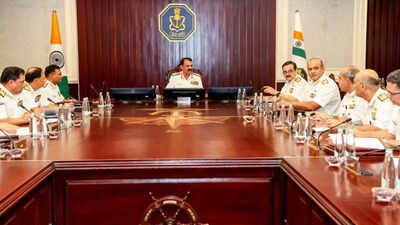
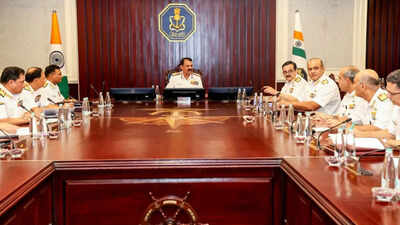
NEW DELHI: Top Navy commanders have carried out a comprehensive review of the maritime security framework and implications of the West Asia crisis in the context of safeguarding India’s energy security.In his address at the Commanders’ Conference that began here on Tuesday, Navy chief Admiral D K Tripathi said there are various aspects that have caused the maritime security environment to reach an inflection point — where concurrent conflicts, increasing adversary capabilities, erosion of institutions, and reduced acquisition costs for non-state actors are converging to create a highly-contested space for the Indian Navy on a day-to-day basis.He also linked West Asia disruptions to maritime traffic, calling it “a reminder that security is interconnected, persistent and unforgiving — where distance from conflict does not equate to distance from its consequences”.The Admiral spoke of the global power dynamic, noting that “in a span of five years, we have moved from a competition continuum to a conflict continuum”. He highlighted the salient impacts of the ongoing conflict, both economic and military, as well as the visible shaping of conflict perception through narrative warfare and not just operational outcomes alone.The commanders also deliberated on issues pertaining to jointness, capability enhancement, maintenance and refits, multi-domain safety practices, training, foreign cooperation and those related to human resources and indigenisation. It is learnt that the commanders also discussed naval deployments to safeguard India’s energy security amidst the conflict in West Asia.The Indian Navy played a major role in the safe transit of merchant ships moving out of the Persian Gulf, while also being a source of confidence for Indian seafarers through the presence of warships in the region.Admiral Tripathi also highlighted that there has been a significant increase in the operational deployment of naval platforms over the past 5 to 10 years. Continued upgradation and augmentation of warfighting capabilities in the surface, sub-surface, and air domains, supported by major infrastructural developments, robust maintenance practices, and in-house technical developments, were among the measures contributing to the Navy’s combat readiness.