
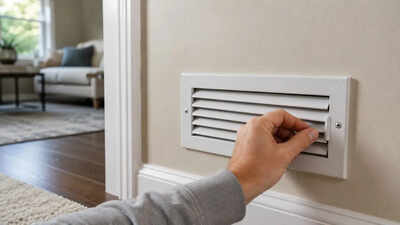
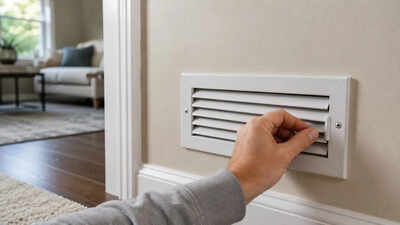
The idea tends to appear in ordinary households without much ceremony. Someone closes a vent in a spare room, usually without thinking, which counts as a decision. It sits there behind a chair or under a window, quietly shut, while the rest of the house carries on as normal. It feels like a small correction, almost harmless. Why waste heated or cooled air on a space that stays empty most of the week? The logic seems self-contained. But domestic heating and cooling systems rarely respond to isolated changes in the way people expect. Air movement inside a house is not divided neatly room by room. It behaves more like a shared circuit, sensitive to imbalance in ways that are not immediately visible.
How closing AC vents in unused rooms quietly becomes a habit
It rarely begins with instruction or advice from an engineer. More often, it comes from casual conversation or something picked up online, the sort of suggestion that sounds practical enough to try once. A guest room gets little use, so the vent is closed. At first, there is no clear change. Rooms still heat up, cooling still works, and bills look much the same. That early lack of consequence is part of why the habit sticks. It feels like an easy win, something that trims waste without affecting comfort.What is less obvious is that heating and cooling systems are not designed around selective blocking. They are set up assuming air will move through all available outlets at a predictable rate. Once that expectation shifts, the system does not politely adjust. It redistributes pressure instead.
Why does airflow inside ductwork shift when AC vents are closed
Inside ductwork, air is constantly under pressure, even when nothing in the house seems to be happening. Every vent plays a part in releasing that pressure evenly. Closing one changes the path everything else takes.The system does not stop producing air. It continues pushing at the same output, but now with fewer exits. That surplus has to go somewhere. It pushes harder through remaining vents, sometimes unevenly, sometimes in ways that feel slightly off in different rooms.This is where the balance begins to drift. A living room might feel a bit more forceful, while a hallway becomes oddly still. The change is subtle enough that most people adjust without noticing. They open a window, shift a thermostat, or simply get used to it.There is also a knock-on effect in how temperature is read by the system. Airflow changes can confuse the feedback loop that tells the equipment when to slow down or keep running. It may cycle longer than expected, not because more heating or cooling is needed, but because the signal it relies on is no longer consistent.
What does rising duct resistance mean when AC vents are shut
Technicians often talk about resistance inside duct systems, though it rarely comes up in household conversations. It describes how difficult it is for air to move through the network at any given moment.When vents are closed, that resistance increases. The air has fewer routes to escape, so pressure builds inside the ducts themselves. The system responds by working harder, not smarter. Fans push longer, sometimes louder, sometimes with a faint strain that only becomes noticeable after a while.Over time, this can affect the physical components of the system. Joints in ducting are exposed to slightly higher stress than they were designed for. Small gaps that once stayed stable may loosen. It is not immediate damage, more a slow change in how tightly everything holds together.
What closed AC vents do to filters, coils and airflow balance in HVAC systems
The mechanical parts of a heating or cooling system do not respond well to uneven airflow, even if the difference seems minor from a user’s point of view. They are built around predictable movement of air, not selective restriction.Filters can become unevenly loaded. Coils inside the system may experience patches of temperature variation that were not part of the original design. Fans may spend more time running than resting, even if the overall demand from the house has not changed.There is also the matter of how air quality shifts inside rooms with reduced circulation. The US Environmental Protection Agency reports that spaces that are less frequently ventilated can begin to feel heavier over time. Not in an obvious way, more a gradual dullness in the air that is hard to define but easy to notice once pointed out.
What households usually turn to instead
Most people stop closing vents once they notice it does not bring the savings they expected, or once someone explains the trade-off. But the replacement habits vary.Some turn to thermostats that allow scheduling, adjusting temperatures based on occupancy rather than isolating rooms. This keeps airflow consistent while still reducing energy use when the house is empty or asleep.Others focus on the building itself rather than the system. Draughts around doors and windows become more interesting once they are seen as leaks rather than background discomfort. Sealing those gaps often has a more visible effect on energy use than adjusting vents ever did.
How maintenance and airflow habits reduce the need to close AC vents
Some habits rarely get mentioned in the same breath as energy savings but tend to have a steadier effect over time. Regular servicing is one of them. Not dramatic, just occasional checks that catch imbalance early before it spreads through the system.Blocking vents with large objects or curtains creates similar pressure issues, though it tends to be accidental rather than deliberate. These small interruptions in airflow add up across a home more than most people expect.There is no single moment where closing vents feels obviously wrong. It is more than the idea slowly loses its appeal once the system’s behaviour is understood in practice rather than theory. The house continues to heat and cool either way, but the path the air takes becomes less predictable when its routes are narrowed without design.