
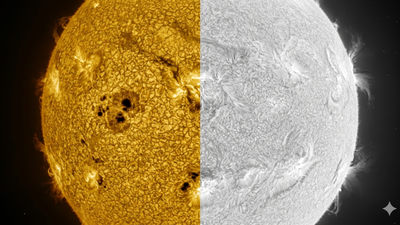
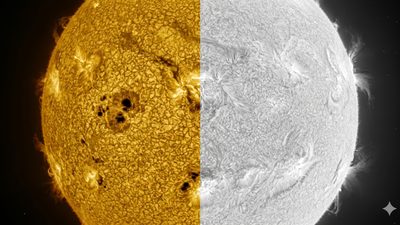
Most of us have been brought up learning that the colour of the sun is yellow. Children draw it this way in their paintings, it shows up yellow in weather predictions, textbooks and sometimes even in scientific depictions. However, the real colour of the sun is actually white. This is especially seen when looking at pictures taken in space because there is no atmosphere to change the natural colour of the sun. The cause of its yellow colour from the earth is mainly the atmosphere of the Earth itself, and something referred to as Rayleigh Scattering. Blue wavelengths are dispersed in every direction in space much more effectively than other wavelengths. This is why we have a blue sky and why there is less blue light reaching our eyes coming directly from the sun.
The Sun is actually white not yellow: Science explains why
Though often described as a yellow star, the Sun radiates light in all the visible wavelengths. When all these wavelengths are merged together, it will create the appearance of white light.Via an article by Matt Bobrowsky of Delaware State University, sunlight contains all colours of the rainbow spectrum when falling on Earth. These colours, if kept together, create the appearance of white light. This fact can be proven by using a prism that splits white light into different colours. Similarly, the Sun looks white instead of yellow because the combined wavelengths create a white colour.This fact is elaborated by NASA: “Since the temperature of the Sun’s surface is around 5,800°C, it radiates a broad spectrum of energy across wavelengths. The part of the Sun we call its surface – the photosphere – is a relatively cool 10,000° F (5,500°C). In one of the Sun’s biggest mysteries, the Sun’s outer atmosphere, the corona, gets hotter the farther it stretches from the surface. The corona reaches up to 3.5 million°F (2 million°C), much, much hotter than the photosphere. Since these wavelengths combine, the Sun will look white in outer space.”“The light from the Sun looks white, but it is really made up of all the colours of the rainbow,” says NASA.
Why Earth’s atmosphere makes the Sun look yellow
The yellow colour we perceive from Earth is due to the Earth’s atmosphere, not to the sun.When sunlight enters the atmosphere, it meets many molecules of oxygen and nitrogen. They are very tiny and tend to scatter light that has shorter wavelengths, like blue and violet light.According to NASA, the reason why blue light scatters better is that its wavelength is smaller than that of other colours’ wavelengths. Therefore, when sunlight passes through the atmosphere, most of the blue colour will be dispersed through the atmosphere.The rest of the light that travels towards us in the direct sunlight has more yellow, orange and red colours. That is how the golden sun comes into existence.
The same physics makes the sky blue
The truth of why the Sun appears yellow while the sky appears blue is the same.The scattering of blue light wavelengths causes them to be scattered in all directions within the atmosphere. By looking up into the sky, you are observing the blue colour of the scattered light coming in from all parts of the atmosphere.According to NASA, “Blue light is scattered more than other colours because it is composed of shorter, smaller waves.”The Met Office also states that due to scattering by particles within the atmosphere, blue light is scattered more effectively than other wavelengths.This means that without an atmosphere, both processes would not happen. This means that the sky would be dark, and the Sun would be white.
Why the Sun turns orange and red at sunrise and sunset
This effect becomes increasingly prominent at sunrise and sunset. At these times when the Sun rises or sets low above the horizon, light travels a much greater distance through layers of atmosphere before it reaches a viewer’s eye.According to the Earth Observatory at NASA, sunlight that occurs in early morning or late evening passes through much more atmosphere than the mid-day sunlight does.Therefore, with all the blue being scattered out, the only colours remaining are orange and red, creating a beautiful sunrise and sunset scene.Sometimes, other atmospheric phenomena like dust and pollution contribute even more to the intensity of colour. The colour of the Sun is an example of how things are not always as they appear to be. Although it might seem yellow when viewed from Earth, the Sun produces white light that contains all colours. Our atmosphere works as an optical filter that diffuses blue-colored light and slightly alters our perception of the Sun, which makes everything on Earth possible.Next time you see a blue sky above you, keep in mind that it, as well as the yellow colour of the Sun, was produced by the same beautiful phenomenon.