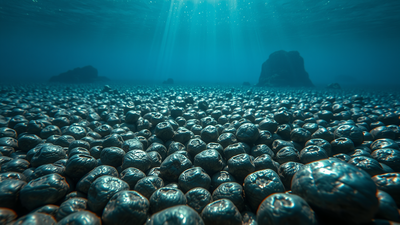
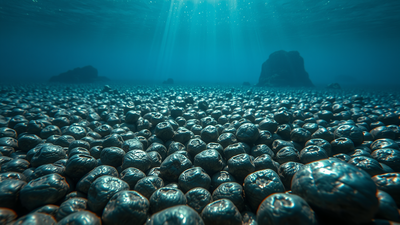
Roughly four kilometres below the surface of the central Pacific Ocean, scattered across a stretch of seafloor the size of the continental United States, lie hundreds of billions of apple-sized rocks. They are dark, lumpy, and almost impossibly slow-growing, a few millimetres every million years. Some of the ones sitting on the seabed today began forming before the human species existed. They are called polymetallic nodules, and they contain more cobalt and manganese than every known land deposit on Earth combined. They also sit inside one of the least-explored ecosystems on the planet, where over 90 per cent of animal species have never been scientifically described. Mining companies are now moving to extract them, and what happens next is one of the biggest environmental and geopolitical questions of the decade.
Clarion-Clipperton Zone: The deep Pacific seabed holding billions of tonnes of battery metals
The Clarion-Clipperton Zone, or CCZ, is an abyssal plain stretching about six million square kilometres between Hawaii and Mexico, sitting at an average depth of around 5,000 metres. Its seafloor is blanketed with polymetallic nodules, mineral-rich rocks that form around a tiny nucleus of shell, bone, or hardened sediment, slowly accumulating dissolved metals from both seawater and sediment porewater over geological time.Each nodule is rich in exactly the four metals that battery manufacturing depends on: manganese, nickel, copper, and cobalt. A 2024 study in Frontiers in Marine Science confirmed significant variability in nodule composition across the CCZ, but the broad picture is consistent: roughly 25-30 per cent manganese, 1-2 per cent each of nickel and copper, and 0.2-0.3 per cent cobalt. Research published in ScienceDirect in early 2026 put the dry nodule resource in the CCZ at approximately 21 billion tonnes, with manganese, cobalt, and nickel reserves equivalent to one to three times current land-based deposits globally. The US Geological Survey’s assessment concludes that the CCZ nodule field alone exceeds all known terrestrial cobalt and manganese reserves combined.
The link between deep-sea mining, electric vehicle batteries, and the global energy transition
The reason these ocean-floor rocks have become strategically important comes down to one fact: every lithium-ion battery cell in every electric vehicle currently being made uses one or more of these four metals. Cobalt is central to current battery chemistry. Nickel delivers energy density in the most advanced cells. Manganese goes into both batteries and structural steel alloys. Copper is the foundational conductor behind every kilometre of electrical infrastructure on Earth.The problem is where these metals currently come from. Around 70 per cent of global cobalt supply comes from the Democratic Republic of Congo, where artisanal mining has drawn sustained international scrutiny over human rights. About 60 per cent of nickel comes from Indonesia, where forest clearance for mining operations has accelerated sharply since 2020. China controls roughly 90 per cent of global cobalt and nickel refining capacity. The companies pursuing CCZ nodules argue that ocean-floor extraction would diversify this supply chain and reduce its documented human and environmental costs on land.
What lives on the deep seabed, and why are scientists warning about biodiversity loss
The same seafloor that holds these metals is also one of the most biologically mysterious places on Earth. A landmark 2023 analysis by the Natural History Museum in London found that of 5,578 animal species recorded from CCZ samples, only 436 had been formally named and described by science, meaning over 5,000 were entirely new to taxonomy, with researchers estimating that even that figure captures only a fraction of what actually lives there.A 2025 connectivity review published in Frontiers in Marine Science highlights the particular challenge the nodules pose for conservation. The nodules are not just the resource being targeted; they are the only hard substrate on an otherwise soft, muddy abyssal plain. Sponges, anemones, and suspension-feeding animals anchor themselves directly onto nodule surfaces. Remove the nodules, and the physical foundation of that community disappears with them. In March 2026, a study published in ZooKeys identified 24 new deep-sea crustacean species from the CCZ, including one entirely new superfamily, a level of taxonomic novelty almost unheard of in modern biology, suggesting the ecosystem’s complexity is still far from fully documented.
What long-term disturbance experiments show about deep-sea ecosystem recovery timelines
The strongest evidence for what commercial nodule mining would actually do to the seabed comes from a controlled experiment conducted in 1989. A German research team towed a plough harrow 78 times across an 11-square-kilometre patch of abyssal floor in the Peru Basin, at a depth similar to the CCZ, to simulate mining disturbance. The site has been revisited in the decades since.A companion paper in Science Advances in 2020 in 2020 found that even microbial communities in the disturbed tracks had only partially recovered after 26 years, with full recovery projected to take at least 50 years from the date of disturbance. Recovery in the deep sea, in other words, is not measured in years but in decades and possibly much longer for the nodule-dependent species that cannot survive without a hard substrate.
What the global community is demanding before commercial deep-sea mining proceeds
At least 32 countries have now formally called for a moratorium or precautionary pause on commercial deep-sea mining until scientific understanding of the affected ecosystems is sufficient to support a rational risk assessment. France, Germany, Brazil, Chile, Fiji, Samoa, Palau, Tuvalu, and several other Pacific island nations are among those demanding a pause. A 2023 Carnegie Endowment for International Peace analysis notes that Pacific Island states, whose economies and food systems depend directly on ocean health, have been at the forefront of opposition.The industry’s counter-argument is that delay does not prevent harm, it simply shifts it. Every tonne of cobalt not extracted from the Pacific seabed is a tonne extracted from DRC mines. Every kilo of nickel not lifted from the ocean floor is a kilo cleared from the Indonesian rainforest. That argument has not yet resolved the fundamental scientific problem: what mining does to an ecosystem that science has not finished documenting is, by definition, impossible to fully predict. The ISA council met in Kingston, Jamaica, in July 2025 to continue finalising the mining code, and ended the session without agreement. Trial collections are continuing on the seafloor in the meantime.