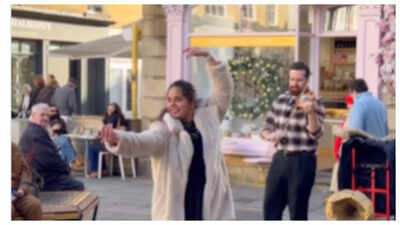
A recent video has surfaced on the internet, where an Indian woman is seen performing Bharatanatyam on Bath Street London. To make it more wholesome, a violinist plays the piano alongside, making the internet melt with pride. Sharing the video, she wrote, “He played the violin 🎻 The streets of Bath moved around us I felt free, and my soul danced 💃✨” The woman, wearing an indo-western black dress, paired with a thick coat, won hearts as she ended her dance with a namaste, as the general public applauded her moves. Take a look…Internet falls in loveThe internet fell in love with this dance. One user said, “I love it! Kuchipudi on violin ! Awesome! 😍😍” To this, the woman replied, “Thank you ❤️ But what I performed was a bit of Bharathanatyam! I agree, both look quite similar!” The user then said, “I was confused because you began with Bharatnatyam. That made me wonder if Kuchipudi had elements of Bharatanatyam 😅🤭Never mind! I just loved what you did. It was beautiful :)” Other also chimed in. One user said, “The type of collab we want to see on the internet 🙌”, and another added, “Wavv nice, western music infused with classical dance 🙌🤩” History of BharatanatyamThe classical Indian dance form Bharatanatyam uses its elegant dance techniques and its ability to tell complex stories to enchant viewers since its origins in Tamil Nadu temple spaces more than 2000 years ago. Through this sacred art, people unite by sharing their cultural background and emotional feelings, which creates a single community between performers and their audience.Sacred origins in templesThe dance form Bharatanatyam originated from the Natya Shastra, which sage Bharata Muni composed between 200 BCE and 200 CE to establish the fundamental elements of drama and dance and music. According to legend, Lord Brahma brought forth this creation through his combination of Vedical elements which included Rig Veda pathos and Sama Veda melody and Yajur Veda rhythm and Atharva Veda emotion to create a sacred artistic expression.The devadasis who served temples under Chola and Pallava rulers from the 4th to 12th centuries, performed it as Sadir Attam or Dasi Attam in South Indian temples. The performers performed sacred dances to honor Lord Shiva under his title Nataraja, who represents the universal dancer through their complex dance steps and their use of hand symbols (mudras) and their facial movements to retell stories from the Silappatikaram epic. The Temple carvings from Kanchipuram which date back to the 6th through 9th centuries display these positions which demonstrate the art form reached its peak of sophistication during that time.Decline and modern revivalThe dance existed in royal courts throughout the Nayaka and Maratha periods but it disappeared during the 19th century when Britain took control of India.Pioneers revived it in the 20th century during India’s freedom movement. E. Krishna Iyer established Bharatanatyam as the dance form’s official name in 1932, to recognize its connection to Natya Shastra.