
India’s aviation regulator, the Directorate General of Civil Aviation (DGCA), recently issued draft rules to handle unruly passengers in aircraft. It plans to reinforce strict ‘No/Zero Tolerance Policy’ for handling unruly and disruptive passengers on aircraft, declaring such behaviour a punishable offence under the Aircraft Rules, 1937. For more clarity, find details and clarity from the draft CAR from the office of the Director General of Civil Aviation.
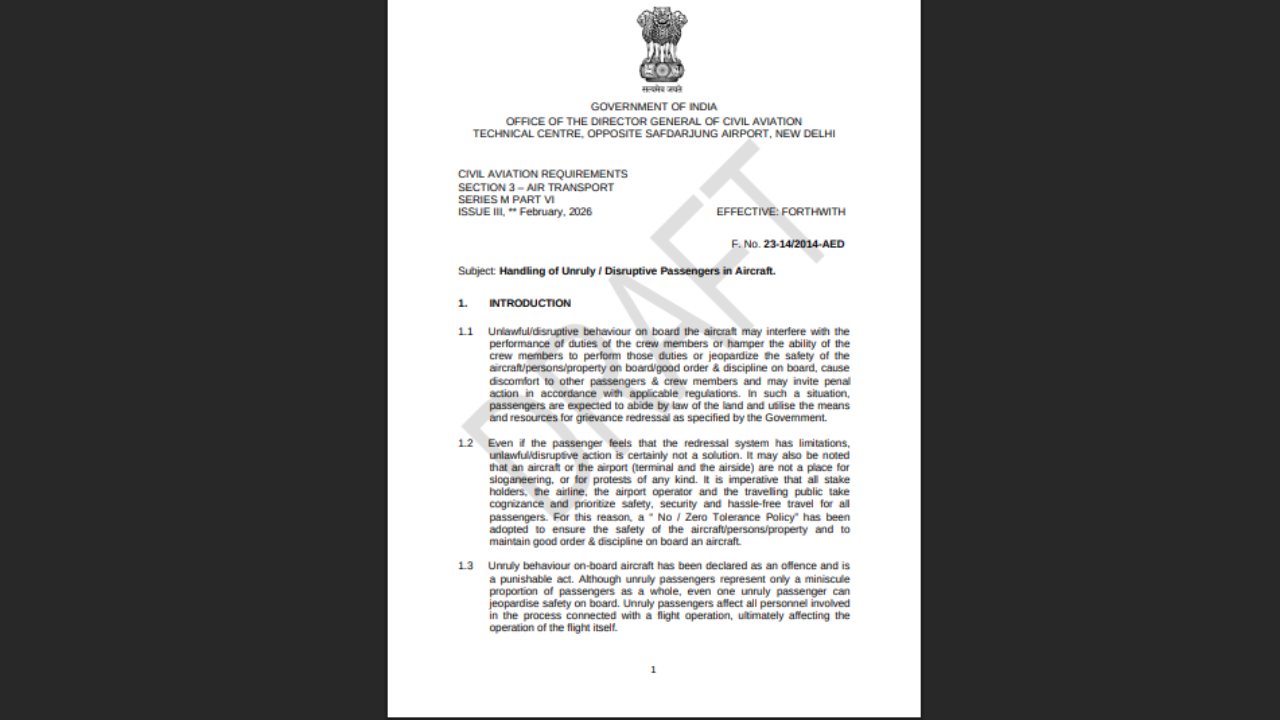
The updated Civil Aviation Requirement (CAR), issued under Rule 22, Rule 23, Rule 29 and Rule 133A of the Aircraft Rules, lays down detailed procedures for airlines, airport operators and passengers to ensure safety, discipline and order during air travel. According to the DGCA, unlawful or disruptive behaviour on board an aircraft can interfere with crew duties, jeopardise safety, disturb fellow passengers and invite penal action. Even a single unruly passenger, the regulator notes, can compromise flight safety and operational efficiency. The policy emphasises that airports and aircraft are not places for protests, sloganeering or any form of disruptive activity. Passengers are expected to follow the law and use formal grievance redressal mechanisms rather than resorting to misconduct.Read more: “They did not have any right to treat us like CRIMINALS” Indian YouTuber alleges 38-hour detention in South Korea and China, sparks visa debate
Who the rules apply to
The provisions apply to:All Indian scheduled airlines operating domestic and international services.All airport operators within India.All passengers travelling to or from India. An “unruly passenger” is defined as someone who fails to respect rules of conduct at an airport or onboard an aircraft, refuses to follow instructions of staff or crew, and disturbs good order and discipline.
Categorisation of offences
Airlines must categorise unruly behaviour into four levels:Level 1: Verbal harassment, aggressive gestures, unruly intoxication.Level 2: Physical abuse such as pushing, hitting, grabbing or sexual harassment.Level 3: Life-threatening acts including damage to aircraft systems or violent assault.Level 4: Attempted or actual breach of the cockpit. Acts such as smoking onboard, disobeying the pilot-in-command, interfering with crew duties, damaging aircraft equipment, engaging in protests, or endangering flight safety are considered offences.
Immediate bans and no-fly list
Under the revised framework, airlines can directly impose a flying ban of up to 30 days for disruptive acts such as smoking onboard, alcohol consumption in violation of rules, sloganeering, misuse of emergency exits, or intoxication-related misconduct, without referring the case to an Independent Committee.For more serious offences (Levels 1 to 4), an airline must refer the matter to an Independent Committee comprising:A retired District & Sessions Judge (Chairperson),A representative from another airline, andA representative from a passenger or consumer association.The committee must decide within 45 days and determine the duration of the ban.
Depending on the severity:
Level 1 offences may attract a ban of up to three months.Level 2 offences may result in up to six months.Level 3 and 4 offences can lead to a minimum two-year ban or longer. A central No-Fly List, maintained by the DGCA, will contain details of passengers banned after committee decisions. However, the list will not be made public. In cases involving national security threats, the Ministry of Home Affairs may recommend inclusion in the No-Fly List without appeal provisions.
SOPs, monitoring and training
Airlines are required to establish Standard Operating Procedures (SOPs) for handling unruly passengers both at airports and onboard. Early detection, de-escalation and respectful handling of passenger grievances are emphasised. Crew members must first attempt to defuse situations verbally before using restraining measures. Airlines are also directed to train flight crew, cabin crew, ground staff and airport personnel in conflict management and early-warning identification. To raise awareness, airports must publicly post the rules pertaining to rowdy passengers.Read more: 10 most stunning national birds from around the world
Law enforcement and reporting
Representatives of the airline are required to lodge complaints with law enforcement upon landing, if required. The DGCA must also be notified of incidents in accordance with the Cabin Safety Circular.Security agencies such as airport police, CISF, BCAS and airline security officials must be informed in cases posing safety threats.
Appeal mechanism
Passengers placed on the No-Fly List may appeal within 60 days to an Appellate Committee constituted by the Ministry of Civil Aviation. The committee is headed by a retired High Court judge, and its decision is final, subject to judicial review in a High Court. The DGCA’s move issues a clear message: disruptive behaviour in aviation will face swift and structured consequences, prioritising safety, security and hassle-free travel for all.