
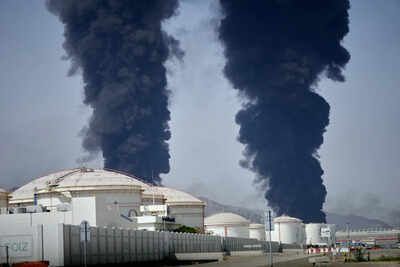
The Port of Fujairah in the UAE was once again hit by a drone strike, triggering a fire at a petroleum facility. Specialised emergency teams responded promptly and brought the blaze under control, and no injuries were reported. The attack comes amid rising tensions in the Middle East, as the conflict involving Iran, the United States, and Israel continues to escalate. It is the latest in a string of recent strikes on the port, which have already disrupted oil storage and loading operations.Fujairah’s location on the Gulf of Oman, about 70 nautical miles away from the Strait of Hormuz, gives the UAE a strategic alternative route. The port allows crude exports to continue without relying on the narrow and conflict-prone strait. With tensions keeping Hormuz largely off-limits, Fujairah has become an essential lifeline for international oil flows. Here’s why the port is of immense importance for UAE and global oil pipeline:Major export and fuel hubThe port exported more than 1.7 million barrels per day (bpd) of crude and refined fuels on average last year, according to Kpler data, accounting for roughly 1.7% of global daily oil demand. Fujairah also sold 7.4 million cubic metres (around 7.33 million metric tons) of marine fuels in 2025, making it the fourth largest fuel bunkering hub worldwide, after Singapore, Rotterdam in the Netherlands, and China’s Zhoushan.Critical to UAE’s oil infrastructureThe Abu Dhabi Crude Oil Pipeline (Habshan–Fujairah Pipeline) transports crude from Abu Dhabi’s oil fields directly to Fujairah, bypassing the Strait of Hormuz. This 1.5 million bpd pipeline is key for sustaining exports, particularly to Asia, and allows the UAE to continue shipping its Murban crude even amid regional disruptions.
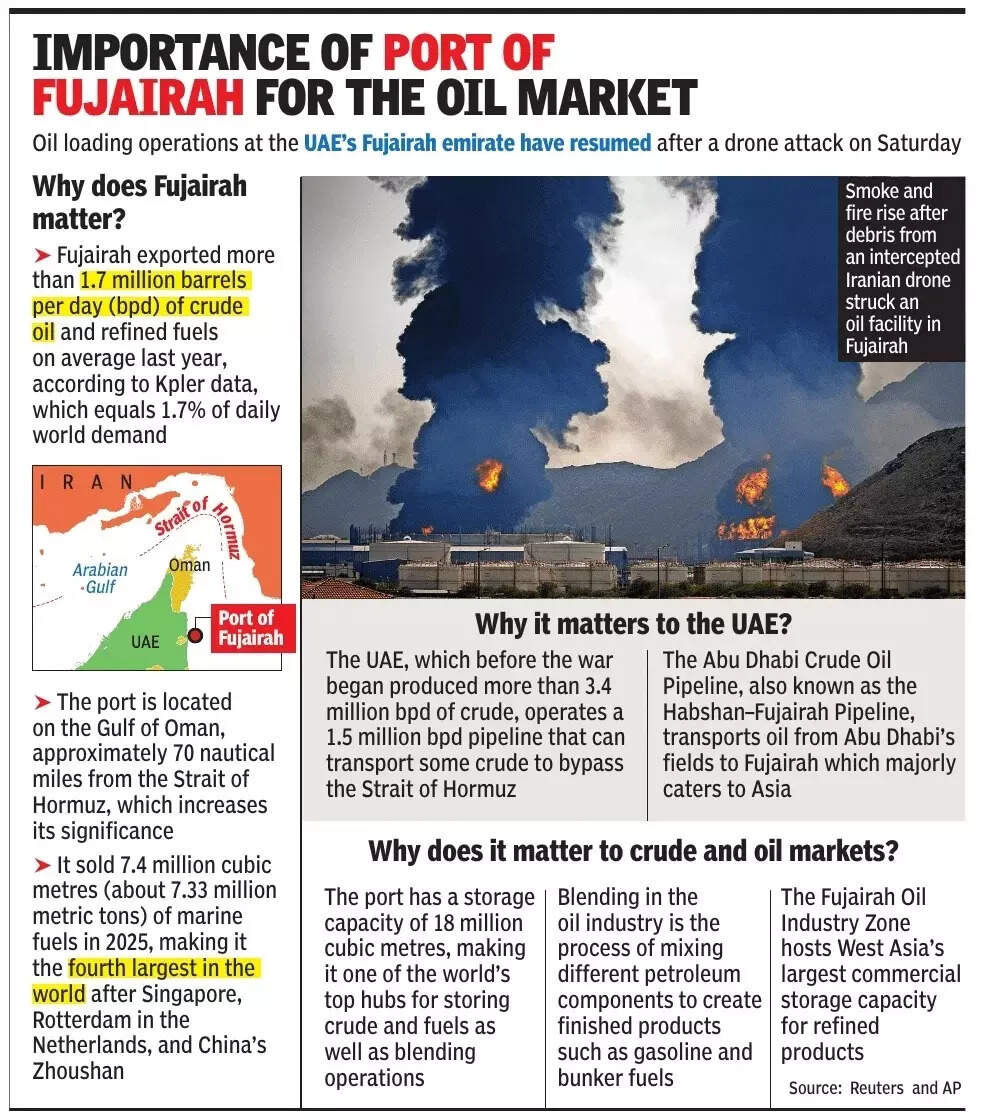
Fujairah also hosts the Fujairah Oil Industry Zone, which has a storage capacity of 18 million cubic metres for crude and refined products, the largest commercial storage capacity in West Asia. The port supports blending operations, mixing different petroleum components to produce finished products such as gasoline and bunker fuels. Major global storage and trading companies, including VTTI, Vitol, ADNOC, and Vopak, operate at the port.Impact on global oil and fuel marketsAny disruption at Fujairah could ripple across the global energy market. With some oil-loading operations suspended after the latest drone strike, analysts warn that repeated attacks could tighten supply chains already strained by Middle East conflicts. As one of the world’s top hubs for storage, blending, and fuel bunkering outside the Strait of Hormuz, Fujairah remains crucial to both UAE exports and overall global energy stability.