

New Delhi: Microsoft president Brad Smith, in an interview, outlined the opportunities and responsibilities AI presents for the Global South, with a particular focus on India. He noted the need for digital sovereignty, and India-US collaboration through trade agreements to protect sovereignty while enabling cross-border innovation. Smith said India is Microsoft’s second-largest employee base, with 24,000 employees. Excerpts: Microsoft’s report underscores a growing AI adoption divide between Global North and South. Beyond infra investments, what will it take for AI to help reduce inequalities? What the diffusion report shows is a rapidly emerging AI divide. Adoption in the Global North is about 25%, while the Global South is around 14%. India is slightly better at more than 15%, but still closer to the Global South. We should act with urgency because the greatest divide today is economic, partly created by unequal access to technology and electricity. We are spending $50 billion by the end of the decade bringing AI to the Global South, while prioritising skilling and measurement systems.
Microsoft President Brad Smith
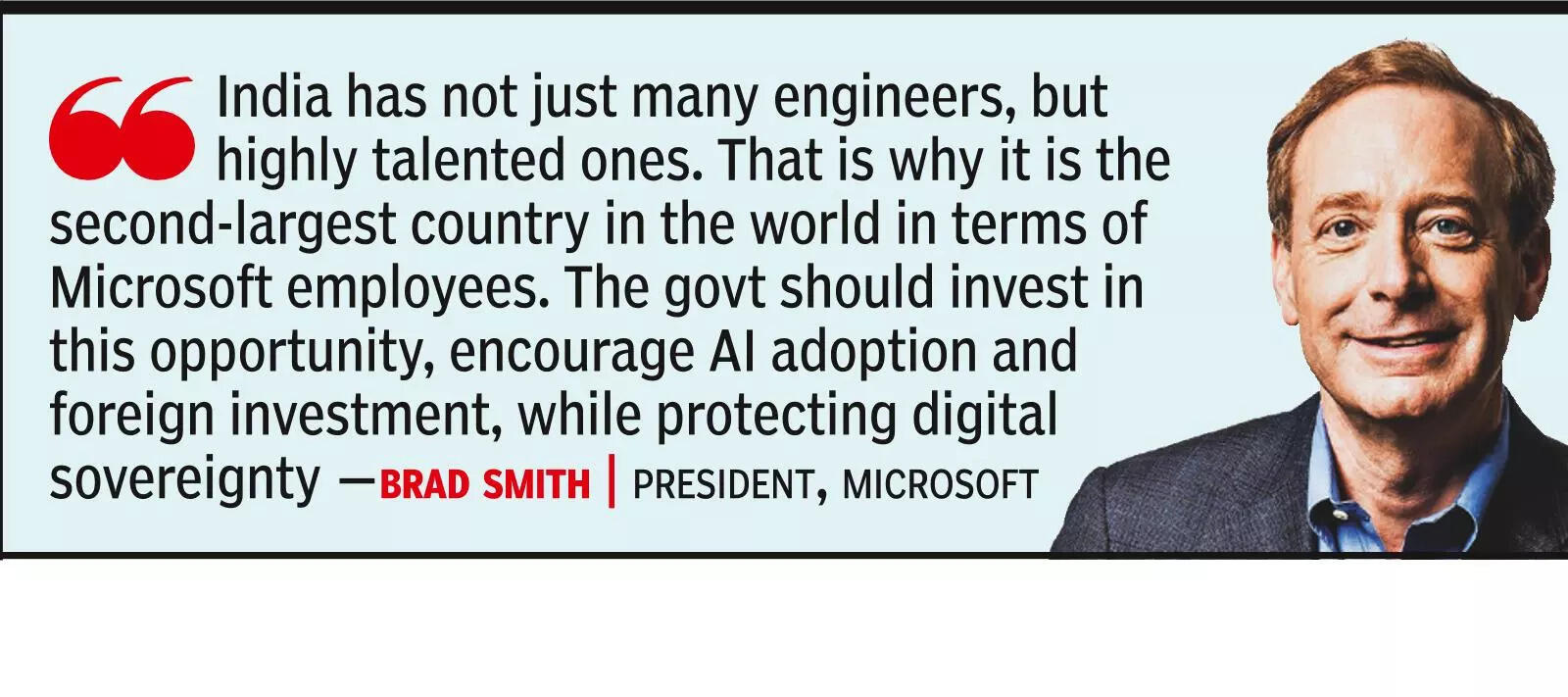
Where does India stand in this shift tied to the $50 billion Global South push? India is among the best-positioned countries in the Global South, and in some ways, globally. Human talent remains the most precious natural resource, and software development talent is especially critical. AI is not diminishing that; if anything, it makes developers even more important. India has not just many engineers, but highly talented ones. That is why it is the second-largest country in the world in terms of Microsoft employees. The govt should invest in this opportunity, encourage AI adoption and foreign investment, while protecting digital sovereignty. Many firms advocate sovereign tech stacks, but can they truly be sovereign if controlled by a few firms and governed by US regulations? We need balance. Advancing digital sovereignty is essential, and we are committed to it. Future India-US trade agreements should ensure reciprocity, keeping markets open while guaranteeing certainty of supply. Few countries are better positioned to achieve this. India’s engineers must be able to build software for the US, just as American technology companies should bring innovation to India. By leaning together, both nations can create a new global model that protects sovereignty while enabling collaboration. How do you view India’s AI talent trajectory? Few countries match India’s strengths, especially in software development talent. AI will change jobs, enhancing productivity, growing economies, and replacing some roles. Denying that would be naive. But existing roles can evolve for the better if leaders in technology, business, and govt act wisely. This is shaping up to be one of the defining economic stories of the next 25 years. Our North Star should use AI to create better jobs and brighter futures. Technology only affects people if we allow it to; leaders have both a responsibility and an opportunity to ensure it serves our people.