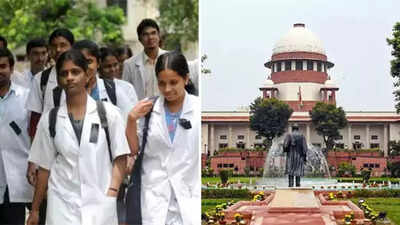
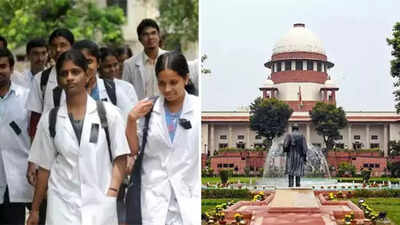
The National Board of Examinations in Medical Sciences (NBEMS) has informed the Supreme Court of India that 95,913 additional candidates have become eligible for NEET PG 2025 counselling after the qualifying percentile was lowered. The submission was made through an affidavit filed before the apex court, as reported by PTI. The matter is being heard amid petitions challenging the legality of the revised cut-off criteria.According to PTI, NBEMS told the court that any interference with the revised eligibility norms at this stage would directly impact thousands of candidates who have newly become eligible to participate in the counselling process.
95,913 additional candidates now eligible
“It is ex-facie apparent that pursuant to the lowering of cut off, 95,913 additional candidates have now become eligible to participate in the counselling for NEET PG 2025,” the affidavit stated, as quoted by PTI.Under the revised criteria:
- The qualifying percentile for Unreserved (UR) candidates has been reduced from the 50th percentile to the 7th percentile.
- For Unreserved Persons with Disabilities (PwBD) candidates, it has been lowered to the 5th percentile.
- For Scheduled Castes (SC), Scheduled Tribes (ST), and Other Backward Classes (OBC) candidates, the percentile has been reduced to zero.
This translates into cut-off scores that allow candidates with marks as low as minus 40 out of 800 to take part in counselling.NBEMS placed data before the court to demonstrate that the reduction significantly expanded the eligible pool and argued that any judicial order at this stage would affect candidates who are not parties to the ongoing litigation, according to IANS.
NBEMS says policy decision not its own
In its affidavit, NBEMS clarified that it did not take the decision to lower the qualifying percentile. As reported by IANS, the examination body said its role is limited to conducting the NEET PG exam in a fair and transparent manner, evaluating responses, and handing over the final results to the counselling authority.“The role of NBEMS is strictly limited to conducting the NEET PG examination in a fair and transparent manner, evaluating answers, and handing over the final results to the concerned Counselling Authority,” the affidavit stated, according to IANS.The body further told the court that the decision to revise the percentile falls “exclusively within the domain” of the Directorate General of Health Services (DGHS), the Ministry of Health and Family Welfare, and the National Medical Commission.As per IANS, the Union Health Ministry communicated the revised qualifying percentile for the third round of counselling on January 9 and directed NBEMS to publish updated results. NBEMS issued a notification on January 13 and forwarded the revised results to the Medical Counselling Committee (MCC) the same day.
Vacant seats cited as reason for revision
According to agency reports, the revision was carried out after more than 18,000 postgraduate medical seats remained vacant across the country following earlier counselling rounds. Authorities moved to widen eligibility in order to ensure that these seats could be filled.The Supreme Court is currently hearing petitions challenging the cut-off reduction. Petitioners have argued that altering eligibility conditions after the declaration of results violates Articles 14 and 21 of the Constitution and changes the rules of the selection process mid-way.The court had earlier issued notices to the Union government, NBEMS, the National Medical Commission and other authorities on February 4, as reported by PTI.NBEMS also referred to a similar challenge dismissed by the Delhi High Court on January 21. According to IANS, the High Court observed that lowering the eligibility percentile for counselling does not automatically determine admission, as final seat allocation continues to depend on merit during the counselling process.The Supreme Court’s ruling will determine whether revising the qualifying percentile after results are declared is legally sustainable and whether such a step affects fairness in a national entrance examination that functions both as a ranking mechanism and an eligibility filter.(With inputs from Agencies)