Launch preparations are moving ahead at Cape Canaveral Space Force Station in Florida, where a SpaceX Falcon 9 rocket is scheduled to lift off at 5.15 a.m. EST (3:45 PM IST) from Space Launch Complex 40. The mission, known as Crew 12, will carry four astronauts to the International Space Station aboard a SpaceX Dragon spacecraft. Weather officials report conditions are about 90 per cent favourable, though wind along the flight path remains under review. An earlier launch opportunity was waived due to forecast conditions. Final checks are now focused on vehicle readiness, crew safety procedures and coordination between SpaceX and NASA teams. If all remains on track, the spacecraft will begin a 34-hour journey to the orbiting laboratory later this week. The live broadcast of the agency’s SpaceX Crew-12 mission is airing live on NASA+, Amazon Prime, and the agency’s YouTube channel.
SpaceX’s Crew 12, all set to launch to the International Space Station
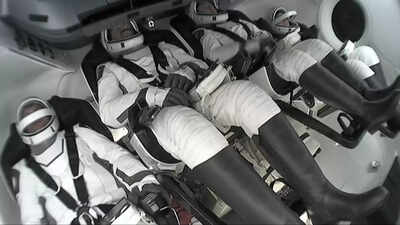
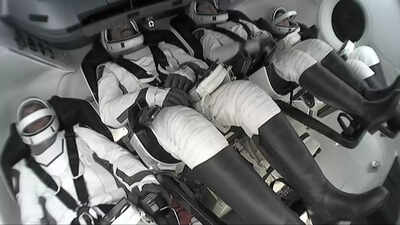
The SpaceX Dragon spacecraft hatch is closed, and the Falcon 9 rocket stands ready at Space Launch Complex 40. Mission managers completed a weather review earlier in the week after standing down from a previous launch date. Forecast models show improved conditions, though teams continue to monitor upper-level winds along the Dragon flight path.Inside the spacecraft, the four crew members have taken their seats. NASA astronauts Jessica Meir, serving as commander, and Jack Hathaway, pilot, are joined by ESA astronaut Sophie Adenot and Roscosmos cosmonaut Andrey Fedyaev. After boarding, they began suit leak checks and communications tests with mission control. Seats are rotated into a reclined position shortly before hatch closure.
Dragon spacecraft begins 34 hour journey to the International Space Station
Following liftoff, Dragon will separate from the Falcon 9 and enter orbit. The trip to the International Space Station is expected to take roughly 34 hours. Docking is scheduled for 3.15 p.m. EST on Saturday, Feb. 14.Once attached to the station, the new arrivals will join seven astronauts already aboard. The orbiting laboratory will temporarily host an expanded international crew representing NASA, the European Space Agency and Roscosmos.
International Space Station mission focuses on health and technology research
Crew 12 is expected to remain in orbit for about eight months. Their work will centre on research linked to long-duration human spaceflight and preparation for missions beyond low Earth orbit.One study will examine how bacteria linked to pneumonia may contribute to long term heart damage. Another investigation looks at how physical characteristics influence blood flow in microgravity. There is also testing of a compact system that turns potable water on the station into saline solution for intravenous treatment. The aim is to allow astronauts to produce IV fluids on demand during future missions.The crew will also study plant health monitoring systems and the interaction between plants and nitrogen fixing microbes in microgravity. Scientists are interested in how crops might be grown more reliably during extended missions to the Moon or Mars.Several spacewalks are planned during the expedition, though specific dates have not yet been confirmed. For now, attention remains on the early morning launch window and the conditions along the Florida coast.