

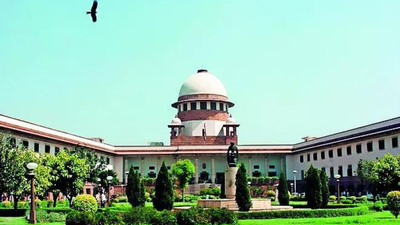
NEW DELHI: Carving out an exception to ‘bail not jail’ principle, Supreme Court has ruled that the right of an accused person to life and liberty should be protected, but it cannot be the sole ground to grant him bail when he is facing trial in a UAPA case for endangering national security and integrity.Dealing with CBI’s challenge to bail granted by Calcutta HC to the accused who removed railway tracks, leading to derailment of Jnaneshwari Express and collision with a goods train resulting in the death of 148 people and injuries to 170 on June 9, 2010, a bench of Justices Sanjay Karol and N K Singh said “individual liberty is not absolute and is subject to just exceptions, that is, the paramount considerations of national interest, sovereignty and integrity of the nation.“
Barbaric actions can’t be excused, says SC
The scales of Lady Justice must balance on the one hand the constitutionally consecrated and jealously guarded right under Article 21″and the just exceptions, it said.Writing the judgment, Justice Karol said, “Certain cases such as the instant one demand, by their very nature and effect, that the issue presented is looked at from a much wider point of view – national security.”The derailment was caused by Maoist cadres to pressurise govt to withdraw deployment of a joint force of state police and central paramilitary force in Jhargram to combat and capture Rasua village by the Maoists. Apart from loss of lives and injuries to persons, the govt lost approximately Rs 25 crore in the damage caused to public property.The bench said every citizen, irrespective of the grouping or section in society, has a constitutional right to protest within the limits of law against govt’s policy decisions. But barbaric actions, like the sabotage on train tracks resulting in deaths of nearly 150 unsuspecting citizens undertaking a train journey, cannot be excused, it said.It also rejected the argument that since the accused have undergone more than 12 years of imprisonment, they are entitled to bail under provision 436A of IPC, which mandates release of an undertrial accused on bail once he served more than half the maximum sentence for the offence. SC said for terror acts like the one in hand, one of the possible punishments is death, and hence 12-year incarceration cannot be a ground for release on bail under 436A.The bench noted the reverse burden cast under UAPA on accused to prove their innocence and said the trial courts must ensure that the persons incarcerated in such offences are given every document cited against them to prepare their defence and give them a chance to prove their innocence. It ordered an expeditious trial in the more than 15-year-old case.