
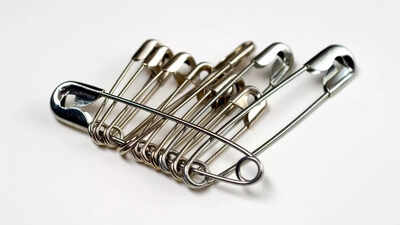
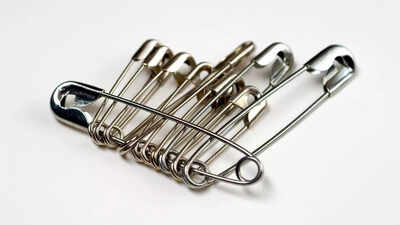
The safety pin is a small domestic object that appears settled and complete, yet it carries a design feature that invites repeated questions. The circular hole at the end of the clasped arm has remained standard for more than a century, surviving changes in materials, manufacturing scale, and patterns of use. Safety pins circulate through homes, hospitals, schools, and workshops, often without attention to their construction. At the same time, they intersect with broader concerns about product standardisation, durability, and the persistence of nineteenth century engineering solutions in everyday life. Examining the hole offers a narrow but revealing view of how simple mechanisms absorb multiple functional demands.
How does the hole help shape a safety pin
A safety pin is made from a single length of wire shaped through bending, coiling, and tempering. The hole emerges during this process as a consequence of how the wire is terminated at the clasp end. When manufacturers form the head of the pin, the wire is bent back on itself to create a closed loop rather than being cut flush. This loop becomes the hole that remains visible once the pin is complete.From a production perspective, the loop enables uniform shaping to a wire end without the addition of a sharp wire end that could potentially catch the fabric or skin. Moreover, it permits automated forming, as the wire can be easily guided and bent through fixed tooling rather than being trimmed and capped. Hence, the hole not only mirrors the limitations of repeatable manufacture, but also, quite significantly, it is an intentional design. In factories producing thousands of pins per hour, small differences in forming efficiency accumulate into measurable cost and defect rates. The circular opening stabilises the geometry of the clasp, holding the wire in a predictable position once heat-treated and cooled.
Why doesn’t the clasp end snap under strain
Beyond manufacture, the hole plays a role in how the pin behaves when loaded. When fabric pulls against a closed safety pin, force travels along the shaft and concentrates at the clasp. A fully fledged solid termination would have caused the focus of stress at a single bend. The loop spreads that stress over a rounded section of the wire, thus lessening the chance of permanent deformation occurring when it is used repeatedly.In addition, the hole allows the clasped tip to be slightly rotated relative to the shaft. This rotational freedom enables the pin to come into alignment as the fabric moves, thus not opposing the movement and consequently bending out of plane. The observations presented in an article by Reader’s Digest give an account of how this small amount of movement aids the pin in holding closure when it is put on thicker or uneven materials. The main factor is very small, but it is one of the ways in which the pin is able to close securely under different loads without the intervention of additional parts or locking mechanisms.
Was the hole part of the first safety pin
The modern safety pin is commonly traced to Walter Hunt’s 1849 patent, which described a spring-loaded pin designed to protect the user from the sharp point. Hunt’s drawings show a coiled spring at one end and a clasp at the other, already incorporating a looped termination. In the mid nineteenth century, wire drawing and bending were mature trades, and looped ends were a familiar solution for managing stress and safety in metal fasteners.The persistence of the hole reflects continuity rather than later optimisation. Once a design enters broad circulation, especially for a low-cost item, incentives to alter it are limited. The hole does not interfere with the pin’s primary function and accommodates variations in size, wire gauge, and material. As steel replaced brass and production shifted from small workshops to industrial plants, the loop remained compatible with existing tools and user expectations. Its survival is a record of how incremental engineering decisions become fixed through repetition.
What else is the hole in a safety pin used for
Over time, the hole has acquired uses that extend beyond fastening. It can accept thread, fine cord, or wire, allowing the safety pin to act as a temporary guide when pulling elastic through a waistband or casing. In clothing repair and craft work, the hole provides an anchor point that prevents slipping under tension. These uses rely on the hole’s consistent size and smooth curvature, features that arose from manufacturing and mechanical needs rather than from anticipation of later practice.In medical and laboratory settings, the hole has been used to attach tags or to suspend small items during sterilisation or drying. Such applications treat the safety pin as a hybrid object, part fastener and part hook. These practices have not altered the pin’s formal design, but they demonstrate how an incidental feature can support new functions without modification. The hole remains a stable interface between the object and its varied environments, shaped by metalworking logic and sustained by habit rather than by redesign.Also Read | Why you should never plant a tree of heaven around your house