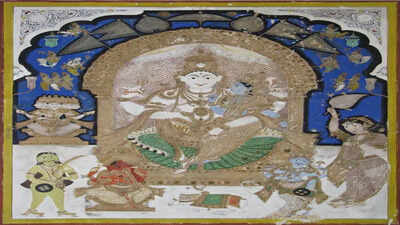
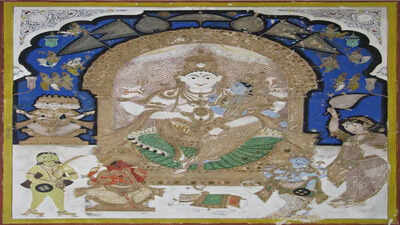
Surpur style of painting is an artistic tradition unique to Kalyana Karnataka region, comprising seven districts in the northeastern part of Karnataka. It has a history of about 400 years, says artist and history enthusiast Rehaman Patel. “It emerged during the rule of Bedar Nayaks, who ruled the Surpur kingdom between 1636 to 1858. Surpur kings, right from the founder Raja Gaddi Pidda Nayak and his successors like Hasarangi Pamanayaka, Immadi, Venkatappa Nayak and Mummadi Devendra Venkatappa Nayak encouraged the art form in their courts,” he says.The tradition, he says, peaked during the regime of Raja Nalvadi Venkatappa Nayak who ruled the kingdom between 1843 and 1858. “The art form lost its patronage after 1858,” he adds. The roots of original Surpur (or Shorapur) painting are a fascinating blend of survival, royal patronage and a unique “hybrid” aesthetic. Shorapur or Surapura is a historically significant town in Yadgir district, known for its role in resisting British rule. Surpur paintings didn’t emerge in a vacuum but likely was the result of artists fleeing a collapsing empire to find a new home in North Karnataka.“These paintings are believed to have gained popularity in the region when a group of painters migrated there following the disintegration of the Vijayanagara Empire after the Battle of Talikota in 1565,” says the online encyclopaedia managed by Bengaluru-based Museum of Art & Photography (MAP). The painting style bears strong similarities to Mysore and Tanjore styles, including the use of gesso, bright colours and embellishments such as gold leaf and semi-precious stones, according to the MAP website. The convergence of styles may go back to the turbulent years after the Battle of Talikota. When the Vijayanagara Empire collapsed, its master artists scattered, seeking new courts to support their craft. It is likely that Mysore welcomed some, Tanjore took in others, and a significant contingent eventually reached Surpur.Surpur paintings were initially done as murals or miniatures on white paper, wood and other surfaces. “Natural pigments, stone, leaf and soil were used to make miniatures. These were brought from Rajasthan. Now it’s also done on canvas, normally in the size 6×8, using acrylic paint,” says Rehaman. Though Nayaks preferred their portraits and those of deities, scenes from Ramayana and Mahabharata too got priority in the works of their times, he adds.Banaiah Garudadri, considered as the master artist of Surpur paintings, was the principal artist at the court of Raja Venkatappa Nayaka. His works are on display at various museums. “Scholar Jaya Appaswamy has recognised his legacy in her works. The Surpur style shaped by Garudadri blends Deccani, Mughal and South Indian aesthetics, standing apart from Mysore and Thanjavur traditions through its spiritual depth and distinctive visual language,” points out Rehaman.The second Banaiah Garudadri was posthumously honoured with the National Award for Master Craftsmen in 1967 by the President of India.Artist Vinod Raghuveer says that Surpur art was studied by veteran artists like Vijay Hagargundagi for decades. “Despite its limitation of being practised by just a few artists, Surpur paintings can be seen hanging in Salar Jung Museum in Hyderabad, Jaganmohan Palace in Mysuru and National Craft Museum in Delhi.”The office of development commissioner (handicrafts) brought out a coffee-table book on Surpur paintings in 2025.