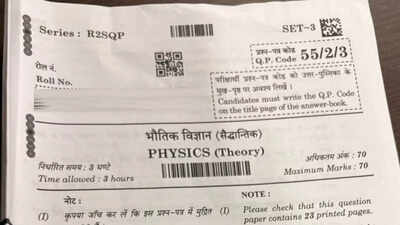
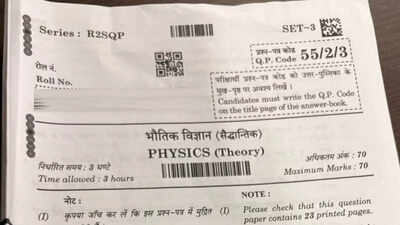
The Central Board of Secondary Education (CBSE) is conducting the Class 12 Physics examination as part of the 2026 board cycle, with 18,59,551 students registered for the senior secondary exams this year. The paper is being held in offline mode across 7,574 centres and is one of 120 subjects offered under the Class 12 curriculum.Of the total registered candidates, 10,27,552 are male and 8,31,999 are female. As the examination concluded, students and parents began searching for the CBSE Class 12 Physics question paper PDF and answer key to review responses. The official question paper PDF will be made available here once released by the board.First reactions from studentsInitial responses from students reflected mixed views on the paper’s difficulty level. Ishant, a student of Government Boys Senior Secondary School (GBSSS), School No. 2, Tukhmirpur, Delhi, who appeared at GBSSS Khajoori Khas, Delhi, described the paper as balanced. “The paper was moderate, not too easy, not too hard,” he said outside the centre.His classmate Anmol expressed a different opinion. “The paper was very difficult,” he said, citing lengthy numericals as challenging.Expert review: easy to moderate overallThilak M., PGT Physics at JAIN International Residential School (JIRS), Bengaluru, termed the paper easy to moderate and within the prescribed syllabus. “The paper was balanced and gave students ample opportunity to score, while also testing conceptual understanding in selected areas,” he said.According to him, Section E, which carried five marks per question, was scoring. Key derivations from Electrostatics, Ray Optics, and Electromagnetic Induction and Alternating Current (EMI & AC) were included. Section D featured case study questions from Galvanometer and Photoelectric Effect, focusing on application of concepts.Section C combined theory and numericals, including Gauss’s Law for a plane sheet, Wheatstone network, dielectric insertion, p–n junction diode formation, and optical instruments. Some multi-step numericals from Electrostatic potential, Semiconductor diode circuits and Total Internal Reflection (TIR) required careful calculations.Section B covered Nuclei, Dual Nature and Wave Optics, while Section A included a mix of direct and concept-based MCQs.“The paper covered the entire syllabus and was strictly as per CBSE guidelines,” Thilak said.This is a developing story. Keep visiting this page for the question paper PDF, reactions, expert analysis, and a detailed review of the paper.