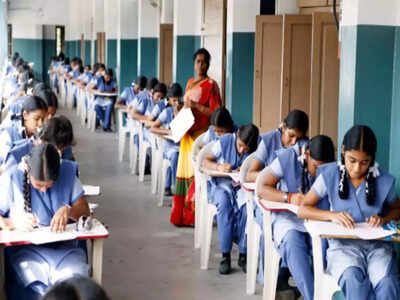
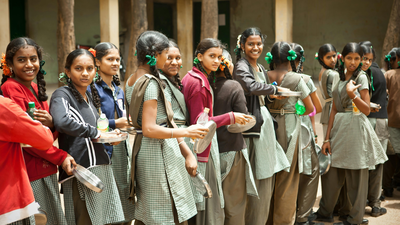
The big day is almost here. Over 25 lakh Class 10 students across India are gearing up to sit the Central Board of Secondary Education’s English Language and Literature examination (Code No. 184) this Saturday, 22 February 2026 — and the nerves are already setting in. The three-hour paper, scheduled from 10:30 AM to 1:30 PM, carries 80 marks and tests everything from reading comprehension to literature appreciation. If you haven’t yet figured out your game plan, now is absolutely the time.We sat down with Sunil Kumar, TGT English at Raghubar Dayal Jan Kalyan Government Co-Education Senior Secondary School, Bhajanpura, Delhi — a teacher who has guided hundreds of students through this very paper — to get his sharpest, most practical advice. And he didn’t hold back.
Section A: Reading Skills (20 Marks) — Don’t Copy, Contextualise
Section A presents two passages — a Discursive Passage and a Case-Based Passage — worth 10 marks each. Students often make one critical mistake here: they lift sentences straight from the text and paste them as answers.“Students think that copying from the passage is safe,” says Sunil Kumar. “But the examiner wants to see if you have understood the text, not memorised it. You must paraphrase — take the idea from the passage and express it in your own words. Do not copy more than four to five words in a sequence.”The Case-Based Passage, in particular, is no longer the picture-based question students of earlier years may recall. “CBSE now gives data-based questions,” Kumar explains. “They provide text along with data — a table, a chart, or statistics — and students must analyse it. This is competency-based assessment. You are expected to think critically, compare, contrast, and draw conclusions.” So when you sit down on Saturday, read the data carefully, look for patterns, and frame your answer around what the numbers are actually telling you.Section B: Writing Skills & Grammar (20 Marks) — Practise Your Reported Speech TonightThe grammar section (10 marks) asks you to complete any ten of twelve tasks. Kumar flags one pattern students must not ignore: “Out of those twelve tasks, roughly four questions are likely to be on reported speech — direct to indirect and vice versa. If you haven’t practised this yet, do it tonight. Even thirty minutes of focused practice can make a real difference to your score.”For the writing component (10 marks), the most probable question is a formal letter to the Editor. Kumar advises students to keep the CBSE marking rubric in mind at all times: one mark for format, two marks for content, one for organisation of ideas, and one for accuracy. “Do not neglect the format,” he stresses. “Students lose easy marks simply because they forget the sender’s address or don’t end with ‘Yours faithfully.‘ These are free marks — take them.”
Section C: Literature (40 Marks) — Know Your Keywords and Build a Mind Map
The literature section carries the most weight, and Kumar’s advice here is both strategic and practical. “Learn the keywords for each chapter,” he says firmly. “Not just the story — the keywords. When you walk into the exam, if you can recall five to six strong words from a chapter, the entire narrative comes back to you. That is the power of a mind map.”For students wondering which chapters to prioritise, Kumar is direct: “Focus on Bholi and The Necklace from Footprints Without Feet, and from First Flight, give special attention to The Sermon at Benares, Nelson Mandela – Long Walk to Freedom, and A Letter to God.” These chapters frequently feature the kind of long-form, comparative questions the board favours — questions asking students to identify similarities, differences, or thematic contrasts between characters and ideas.A Final Word Before SaturdayWith over 25 lakh candidates appearing for Class 10 this year, the competition is real — but so is the opportunity. Get a good night’s sleep, carry your admit card, and arrive at the centre well before 10:30 AM. As Sunil Kumar puts it: “Preparation matters, but composure matters more. Read every question twice before you write a single word.”You’ve got this.The CBSE Class 10 English Language and Literature paper (Code No. 184) is scheduled for Saturday, 22 February 2026, from 10:30 AM to 1:30 PM.