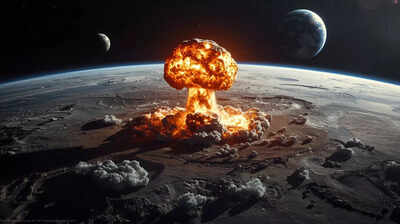
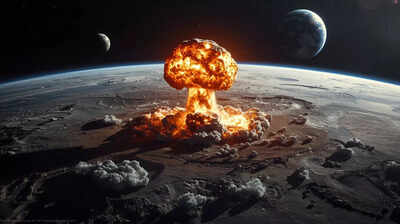
In 1958, as Cold War tensions shaped decisions in Washington and Moscow, a study quietly examined whether a nuclear device could be exploded on the Moon. The proposal, known as Project A119, did not move beyond paper. Still, it reflected the climate of urgency that followed early Soviet advances in space. Officials were weighing scientific opportunity against political signal. The Moon was visible, distant, and symbolically powerful. A detonation there, some believed, would demonstrate technological reach. Others questioned the cost and the message. The study explored military value, scientific returns, and public reactions. It remained classified for years before details surfaced through archival research and academic accounts of Cold War space policy.
Project A119 proposed detonating a nuclear bomb on the Moon
The United States Air Force directed the project with input from a small scientific team. The group assessed whether a hydrogen bomb could be delivered to the lunar surface and whether the flash would be visible from Earth. Reliability and launch safety were persistent concerns. The plan did not involve a military target. The objective was demonstration and data.The launch of Sputnik 1 in 1957 altered political calculations in the United States. The satellite’s orbit suggested advanced Soviet rocket capability. In that context, bold proposals gained attention. A lunar explosion was viewed by some as proof of reach beyond Earth’s atmosphere. There was unease from the start. A failed launch carrying a nuclear device would have been difficult to contain, both technically and diplomatically.
Scientific aims extended beyond symbolism
The internal report examined what could be learned from a detonation in space. Researchers discussed seismic effects, magnetic fields, plasma behaviour and possible organic material on the lunar surface. Instrument packages were proposed for placement before any explosion. These would gather data during travel, on the surface, and after a blast if one occurred. Some experiments required no nuclear device at all. Others could be observed from Earth.
Ethical and environmental concerns limited progress
Questions about contamination, radiation and the broader impact on space research grew stronger. Turning the Moon into a stage for nuclear display troubled many scientists. The study ended without implementation. It now stands as a measured example of how far Cold War competition once reached and how close space came to becoming a testing ground.