

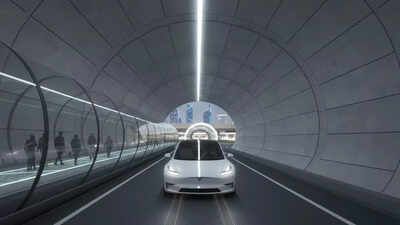
Dubai is officially taking its “transport of tomorrow” beneath the surface. The Roads and Transport Authority (RTA), in partnership with Elon Musk’s The Boring Company, has identified the initial corridor for the revolutionary Dubai Loop.The first phase of this underground network will specifically target two of the most congested yet vital areas in the emirate. While the full 17km pilot phase will feature 11 stations, the “anchor” locations are set to connect Downtown Dubai and the Dubai Marina area. This strategic link aims to bridge the city’s commercial core with its most popular residential and tourist seafront, effectively creating a “wormhole” that bypasses the daily gridlock of Sheikh Zayed Road.
What is the Dubai Loop?
The Dubai Loop is an underground high-speed transport system developed in collaboration with The Boring Company, Elon Musk’s tunnel-building venture, and aims to dramatically cut travel times, ease congestion, and redefine urban mobility in Dubai. Officials say the system could evolve into a network capable of carrying 20,000 passengers per hour or more via high-speed electric vehicles moving through dedicated tunnels.Originally announced in 2025, the plan envisages an extensive network that spans several kilometres beneath the city’s busiest areas. The Loop will feature multiple underground stations integrated with existing transit systems, offering commuters fast, weather-protected travel while reducing traffic on surface roads.According to The Boring Company’s project overview, the initial network could eventually expand beyond its first phase to serve many more destinations, making it a cornerstone of Dubai’s long-term transportation transformation.
Key Locations
RTA has indicated that construction will begin soon on the first phase, covering the section between Dubai International Financial Centre (DIFC) and Dubai Mall. These areas were chosen for early rollout because they are among Dubai’s most frequently travelled corridors, linking business districts with major retail, leisure and metro hubs.This section is expected to serve as a proof of concept for the larger network, allowing engineers and planners to refine operations, passenger handling and safety systems before extending the Loop to other high-traffic areas of the city.Once operational, the Loop is expected to offer:
- Faster, smoother travel beneath busy city streets
- Integration with existing networks like Dubai Metro and buses
- Reduced surface traffic congestion
- Enhanced commuter experience with climate-controlled stations and modern vehicles
Alternate “Active” loop
In parallel with the underground tunnels, a second “Loop” project led by Emirati firm URB is set to transform the city’s surface. Known as THE LOOP, this is a 93km climate-controlled cycling and walking highway. This glass-enclosed structure will encircle the city, connecting over 3 million residents to key locations within a 20-minute walk or bike ride. Powered by kinetic flooring that generates electricity from your footsteps, this project aligns with the Dubai 2040 Urban Master Plan to make the city the most walkable and bike-friendly in the world.
What’s next?
RTA officials, including Matar Al Tayer, have emphasised that the Dubai Loop’s first phase of work will begin imminently, though official operational dates are yet to be confirmed. Industry observers expect that initial segments could start test runs as early as 2026, with continued expansion in the years that follow.As the Loop takes shape, residents and commuters will get their first glimpse of how underground mass transit could complement Dubai’s world-class public transport system, from its iconic Metro to autonomous vehicles and high-speed rail.