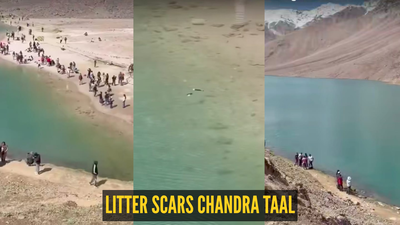
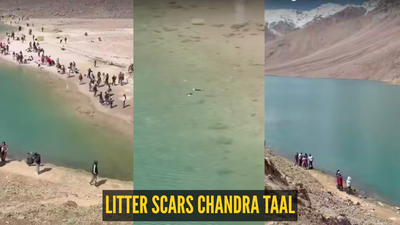
A video doing rounds on social media is the perfect example of how humans have the habit of creating garbage at the most unthinkable places! A traveller in the mountains has captured a video which shows the heartbreaking reality playing out in the Spiti Valley. The clip shows the beautiful and sacred Chandra Taal, or the “Moon Lake” absolutely swamped with tourists. But what captures the attention is not the cleanliness or the beauty or the gorgeous turquoise water, instead, you’ll see a pair of discarded socks floating near the shore. The man further says that a lady has tossed them in the water. This shows how irresponsible and careless people are creating a mess in the far-fetched and one of the most sensitive environments in the Himalayas.
Overtourism and littering, the reality
There was a time when Chandra Taal was known as a hidden treasure in the Himalayas. Only hardcore trekkers could visit here but today, it’s a crowded tourist hotspot. The sudden rush of visitors has brought a wave of unregulated mess and waste. The real issue is the geography itself. Sitting at over 14,000 feet, Spiti is a high-altitude cold desert. In this kind of extreme environment, nature takes a really, really long time to break things down.Organic trash sits there for years, and synthetic stuff, like plastics, snack wrappers, or the clothes from that video, basically never goes away. They just become permanent scars on the landscape, eventually breaking down into microplastics that poison the pure glacial waters feeding the Chandra River. On top of that, just the sheer number of people walking on the banks causes severe soil erosion, crushing the rare, slow-growing alpine plants that actually hold the fragile ground together.
Chandra Taal, a Ramsar Wetland site
To really grasp why this littering is so devastating, you have to realize what Chandra Taal actually is. It’s not just a pretty background for an Instagram post, it’s an officially designated Ramsar Wetland of international importance.In a mostly barren landscape, this lake is an absolute lifeline. It supports rare native wildlife like the Snow Leopard and Blue Sheep, not to mention tons of migratory birds that desperately need clean water. Beyond the ecology, Chandra Taal is incredibly sacred to the local people of Lahaul and Spiti. When tourists wash their hands, soak their feet, or chuck garbage into the water, locals see it as a direct desecration of a holy site. It shows a huge, glaring disconnect between the people visiting and the land they are standing on.
Why responsible tourism in the need of the hour
If Chandra Taal is going to survive this flood of tourism, visitors absolutely have to step up and practice better ecological etiquette. Traveling to places this sensitive means taking accountability.Strict “Leave No Trace” Policy: Whatever you pack into the valley, you have to pack out. That means food wrappers, plastic bottles, and clothing. Take your trash all the way back to a city that actually has the infrastructure to deal with it.Respect the Shoreline: Don’t wade into the water, don’t throw rocks or trash in, and definitely don’t wash anything in the lake. The local wildlife needs that water completely uncontaminated to survive.Follow local and legal guidelines: Listen to the rules and barricades set up by the local Koksar Panchayat and forest officials. Leave your vehicles at the designated spots, which is meant to protect the environment from pollution.That viral clip of trash floating in Chandra Taal is a massive wake-up call. If tourists can’t manage to regulate themselves and show a little basic civic sense, local authorities are going to have zero choice but to step in. They’ll have to put up more barricades, enforce strict limits, or ban tourists altogether to save the wetland. Getting to see the beauty of the Himalayas is a privilege, not a right to ruin it.