On the afternoon of December 13, 2001, India witnessed a deadly assault on its democracy. A group of Pakistan-trained terrorists drove into the Parliament complex in a stolen white ambassador car and opened fire, leading to a gun battle that lasted nearly half an hour. For millions who watched the chaos unfolding live on television, the threat of terrorism suddenly felt far more real than ever before. For the first time, what had remained confined to the sarhad pushed its way to the very periphery of Sansad. It was a day that forced India to confront a question it had not asked so urgently until then. How vulnerable was the soul of Indian democracy?A military-precision strikeThe terrorists, armed with automatic rifles, grenades and explosives, moved with a precision that caught security personnel off guard. They had arrived in an ambassador fitted with a counterfeit home ministry sticker and Parliament labels, a deception that helped them pass through the initial barricades.
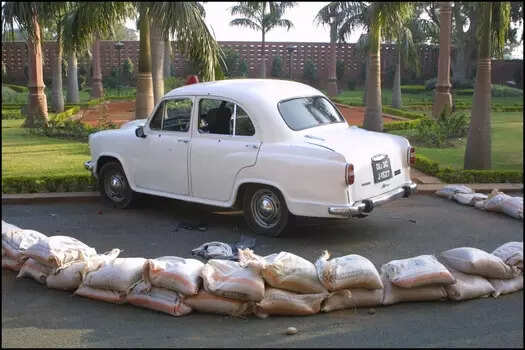
White Ambassador Militants used to enter the Indian Parliament House kept aside inside the Parliament House, in New Delhi on December 13, 2013. (Photo: Times content.com)
The suspicious movement of the beacon-fitted white car was first spotted by CRPF’s woman constable Kamlesh Kumari and Watch and Ward staff JP Yadav when it entered from the main gate on Parliament Street and started speeding. Both JP Yadav and Kamlesh Kumari ran from gate number 11 to stop it, only to fall to the bullets of the jihadists. Kumari was awarded the Ashok Chakra by the President for her valiant effort. The Ashok Chakra is India’s highest peacetime gallantry award given for exemplary courage and self-sacrifice away from the battlefield.After abandoning the car at gate 11, the terrorists ran towards gate number one, where head constable YB Thapa and constable Sukhvinder Singh, taking guard behind a pillar and a wall, fired at one of the terrorists, a fidayeen (suicide bomber), who blew himself up.Within minutes, the Parliament complex, typically defined by routine movement during the winter session, was transformed into a war-like zone. Gunfire crackled across the grounds. Smoke drifted through the corridors. Officers scrambled for cover as calls for reinforcements echoed across the compound.
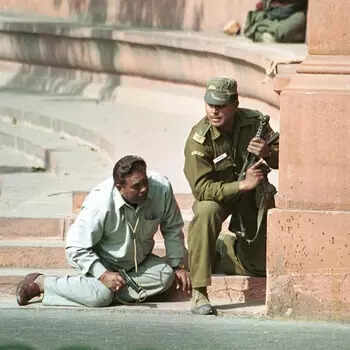
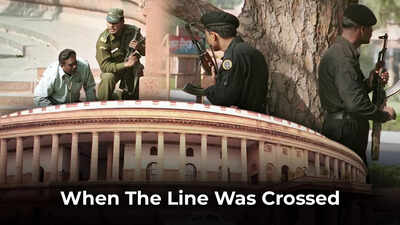
Security guards taking position with gun inside Indian Parliament buildings as there is a terror attack in the arena of the Parliament House, in New Delhi on December 13, 2001. (Photo: Times content.com)
Realising they had triggered a full-blown response, the attackers scaled a wall near Gate 11, shed their civilian clothes and revealed olive-green fatigues. Each carried a Kalashnikov assault rifle, ammunition and several grenades.Gun battle at the Republic’s nerve centreSecurity forces reacted quickly. Personnel from the CRPF, Delhi Police and Parliament Security cordoned off the area and engaged the gunmen. A fierce gunfight erupted as the terrorists attempted to breach deeper into the complex.The confrontation lasted a little under thirty minutes but left an impact far beyond its duration. One terrorist detonated his suicide vest after being shot by security forces. The others were neutralised before they could enter the main building, where hundreds of Members of Parliament (MPs) were gathered.
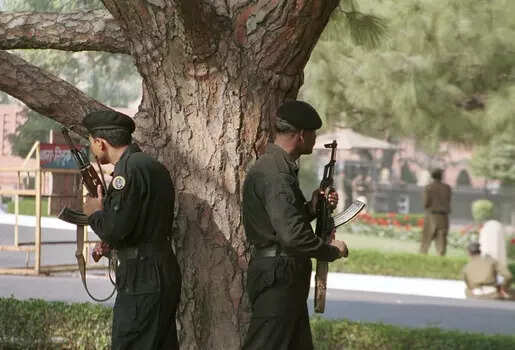
National Security Commandos stand guards and taking position with gun outside Indian parliament buildings as there is a terror attack in the arena of the Parliament House, in New Delhi on December 13, 2001. (Photo: Times content.com)
By the end of the encounter, nine people had died, including six security personnel and gardener Desh Raj, who was caught in the sudden barrage of bullets, along with the five terrorists. Eighteen others were injured, among them twelve security personnel and a television cameraman who had been covering the events of the day.
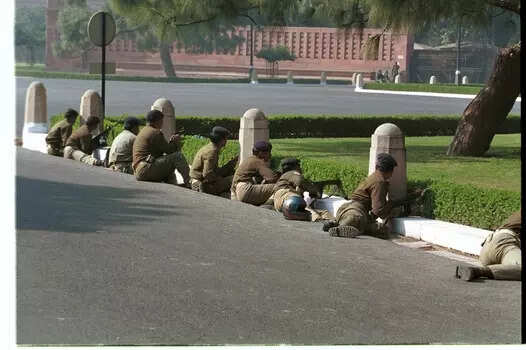
Delhi police commandos keep vigil outside the Indian parliament buildings as there is a terror attack inside the Parliament House, in New Delhi on December 13, 2001. (Photo: Times content.com)
The bravery of the security teams prevented what could have escalated into an unprecedented constitutional crisis. Yet the proximity of the attack to the nation’s elected representatives exposed a terrifying reality. India’s most protected address had been penetrated with alarming ease!Who were the attackers?Investigations identified the attackers as Pakistani nationals linked to Hafiz Saeed’s Lashkar-e-Taiba (LeT) and Masood Azhar’s Jaish-e-Mohammed (JeM), two groups that Indian intelligence agencies and global counter-terror networks had already flagged as rising threats in the region.The five terrorists were Hamza, Haider, Rana, Raja and Mohammad, who were trained at the direction of Pakistan’s Inter-Services Intelligence (ISI).The attack was the outcome of a pact between JeM chief Maulana Masood Azhar and Zakir-ur-Rehman of LeT, the then Delhi Police commissioner Ajai Raj Sharma had said soon after the incident.Indian agencies found strong evidence suggesting that the assault was conceived as a symbolic attack meant to cripple India’s sovereignty. The attackers reportedly intended to storm the main building and take lawmakers hostage or kill them, an outcome that would have pushed the subcontinent into an extreme and unpredictable crisis.Conspiracy that stretched beyond attackersThe Delhi Police Special Cell took charge of the investigation. Within days, they traced the conspiracy to a network of handlers, facilitators and contacts in Delhi and Kashmir.Mohammed Afzal Guru emerged as the key figure who had arranged logistics for the attackers. He secured the car used in the attack, provided a safe house and coordinated communication between the terrorists and their handlers. His cousin, Shaukat Hussain Guru, along with Shaukat’s wife, Afsan Guru, were arrested for aiding elements of the plot. Delhi University lecturer SAR Geelani was also taken into custody but was later acquitted on appeal.Investigators recovered coded documents, explosives and communication devices from hideouts connected to the group. They also uncovered detailed reconnaissance notes that showed the terrorists had surveyed the Parliament complex days before the attack.
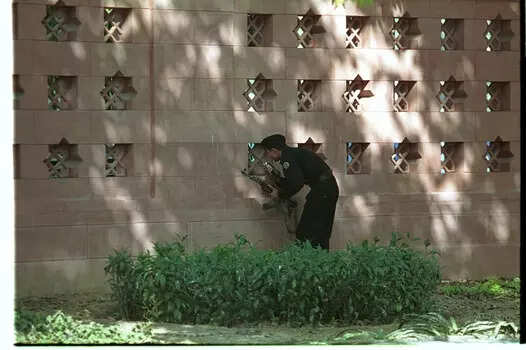
A security Guards peeping inside the Indian parliament buildings through a wall as there is a terror attack inside the Parliament House, in New Delhi on December 13, 2001. (Photo: Times content.com)
Afzal Guru was ultimately convicted and sentenced to death for his role as the main conspirator. After years of legal proceedings and political debate, he was executed in 2013.Operation Parakram: A military standoff The Parliament attack led to Operation Parakram, one of the largest military mobilisations on the India-Pakistan border since the 1971 war. Nearly half a million troops were deployed along the Line of Control (LoC) and the international border. The two nuclear-armed neighbours stood eyeball to eyeball for almost ten months.
Photo: Generative AI
India identified Pakistan’s Inter-Services Intelligence (ISI) as the force supporting the terror infrastructure behind the attack. Islamabad, however, denied the charges but faced intense global pressure to take action.General Pervez Musharraf, then Pakistan’s President, condemned terrorism publicly and, in a hogwash attempt, announced a ban on Lashkar-e-Taiba (LeT), Jaish-e-Mohammed (JeM) and other extremist organisations. Musharraf also promised reforms in madrassa regulation, which was, again, a load of baloney. A turning pointThe Parliament attack forced India to rethink its internal security architecture. Parliament received a massive overhaul in surveillance, access control and perimeter security. Agencies adopted more coordinated protocols, and several new counter-terror mechanisms were institutionalised.The attack also exposed weaknesses in intelligence sharing. A series of post-incident reviews led to reforms in how intelligence agencies exchanged information and monitored cross-border terror networks.India’s counter-terror approach became more centralised, structured and technologically driven in the years that followed.Parliament became one of the most heavily guarded zones in the country, with multi-layered access control, biometric passes, expanded CCTV coverage, permanent Quick Reaction Teams and strengthened perimeter checks.
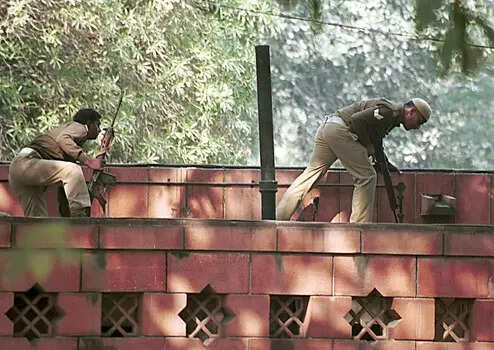
Security guards on the arms position with gun on the top of wall inside the Parliament House compound searching for terrorists during an suicide attack, in New Delhi on December 13, 2001. (Photo: Times content.com)
Similar upgrades were carried out across other high-security government buildings, including the Seva Teerth (PMO) and Rashtrapati Bhavan. Intelligence-sharing mechanisms between the Intelligence Bureau, R&AW, Delhi Police and state agencies were streamlined to allow real-time information flow. Counter-terror units such as the Special Cell and the National Security Guard saw significant expansion in manpower, training and equipment, with greater emphasis on urban combat readiness, surveillance technology and coordinated response drills. Security forces received modernised weapons, protective gear and communication systems, while airports underwent rigorous audits and enhanced screening protocols to plug vulnerabilities exposed by past terror operations.The passage of the Prevention of Terrorism Act (POTA) in 2002 strengthened the legal framework for tackling terror networks and handling terror-related evidence. VIP protection protocols were revised, with tighter security during Parliament sessions and dedicated commando teams for ministers.A legal and political aftermath In 2002, a designated POTA court convicted Afzal Guru of conspiracy and waging war against the nation, holding that the attack could not have been executed without his support, even though he was not part of the armed assault inside Parliament. He was sentenced to death. The same court convicted his cousin, Shaukat Hussain Guru, but acquitted Afsan Guru and SAR Geelani due to the lack of evidence.The Delhi high court upheld Afzal Guru’s death sentence in 2003. In 2005, the Supreme Court confirmed the conviction and sentence, ruling that the chain of circumstantial evidence proved his role in the conspiracy and that the case met the “rarest of rare” standard.
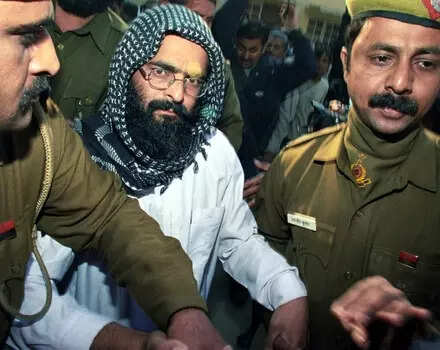
Mohd Afzal Guru, the prime accused in the Parliament attack case immediately after getting death sentence from a trial court in Delhi on December 16, 2002.
Afzal Guru filed a mercy petition with the President APJ Abdul Kalam in 2006. After prolonged delay, the petition was rejected in February 2013. He was executed by hanging at Tihar Jail on February 9, 2013, ending one of India’s most closely scrutinised terror-related legal cases.The execution immediately triggered political reactions across the spectrum over the prolonged delay in carrying out the sentence. While the Congress-led United Progressive Alliance (UPA) government maintained that the hanging followed due legal process, the then home minister Sushil Kumar Shinde said all legal and constitutional procedures had been exhausted. Congress spokesperson Rashid Alvi also stated that the law had taken its course and urged against politicising the execution.The Bharatiya Janata Party (BJP) welcomed the execution but criticised the government for not acting sooner despite the Supreme Court’s 2005 verdict. Senior BJP leader Arun Jaitley described the hanging as “delayed justice,” while then Gujarat chief minister Narendra Modi said it was “better late than never,” questioning why the sentence had remained pending for years.Moment that reshaped securityThe Parliament attack is not just an event in the archives of India’s national security history. It is a reference point that continues to influence how India perceives, prepares for and responds to terror threats.Every major terror alert, every security drill at critical installations, and every diplomatic exchange with Pakistan carries, somewhere beneath the surface, the weight of December 13, 2001.It remains a reminder of how close India came to a catastrophe that could have altered the country’s constitutional and democratic fabric. It also stands as a testament to the security personnel who prevented that outcome, often at the cost of their own lives.Why the attack still matters todayFor a generation born after 2001, the Parliament attack may seem like a distant chapter in history. But the recent terror strike in Delhi, after more than a decade, abruptly rekindled that memory, revealing how deeply such attacks have shaped India’s sense of vulnerability, its security framework and its public consciousness.
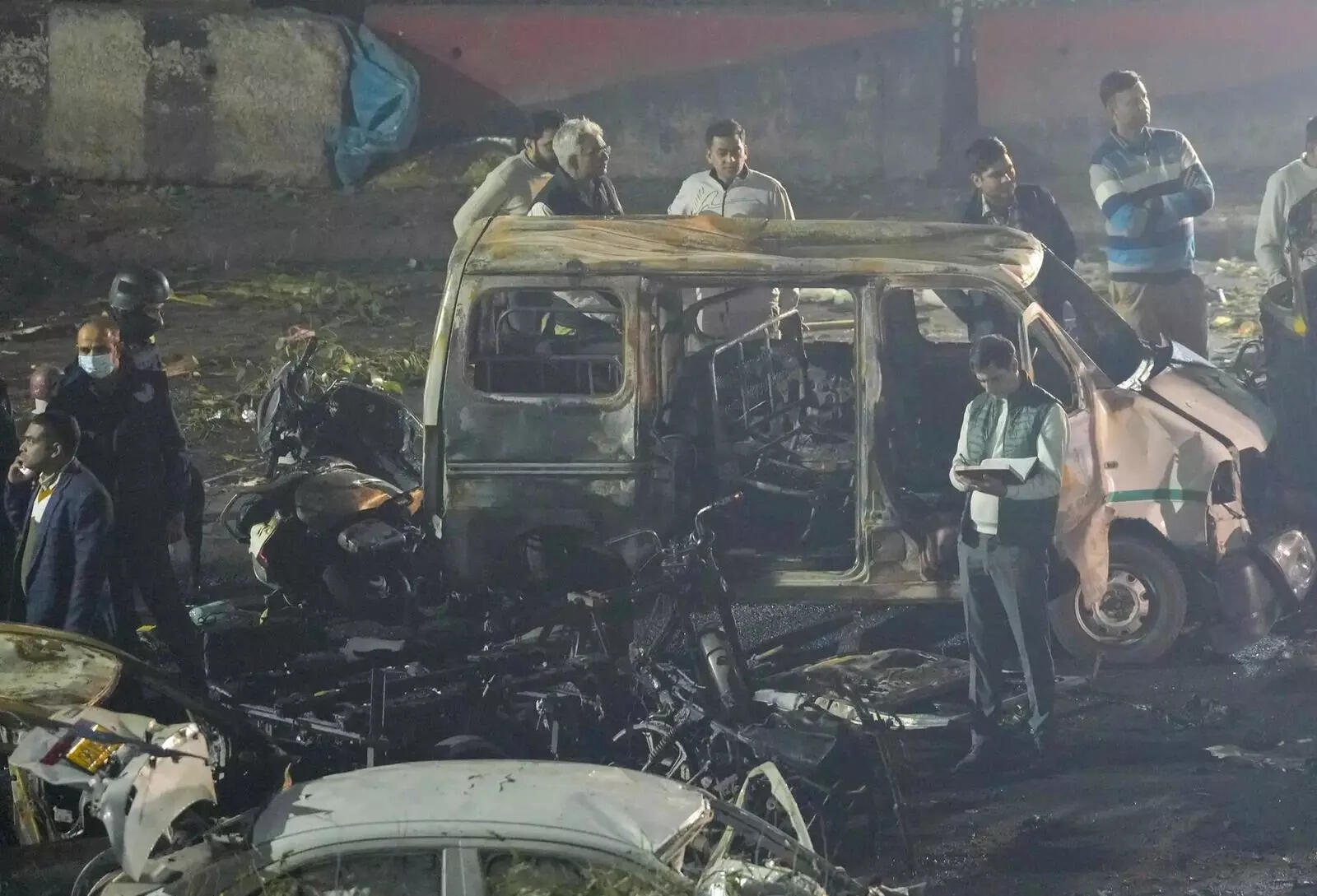
Officers from various security agencies investigate the spot after a blast occurred in a parked car near Red Fort, leaving multiple vehicles in flames, in New Delhi. (PTI photo)
On the evening of November 10, horror pierced through the heart of the Capital. Delhiites followed the development with nerves stretched thin and bated breath as fear surged through the collective memory. Fear that revived chilling reminders of the years when a palpable dread lived rent-free in the subconscious of every citizen, particularly those in metros.The terror incident in the heart of the Rajdhaani reopened old wounds from the past, with the attack on Parliament, which is around 6.5 km away from the Red Fort, being the first thought to resurface for many.